
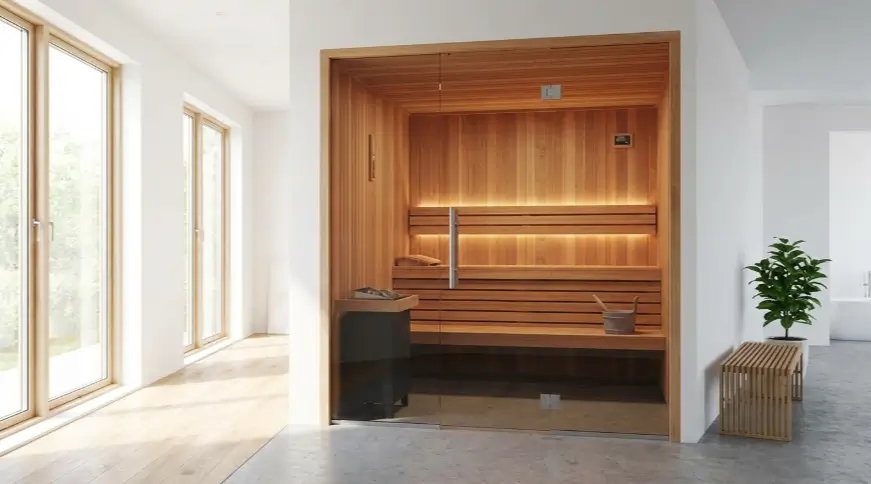
Cedar vs Heat-Treated Hemlock for an Indoor Sauna
Western red cedar and heat-treated hemlock are the two most common wood choices for an indoor sauna cabin, and the decision usually comes down to budget versus aroma and slight moisture-resistance advantage. Cedar typically costs 20 to 40 percent more than hemlock for a comparable cabin, carries a stronger natural scent, and resists moisture and warping slightly better without added processing. Heat-treated hemlock, when properly kiln-dried, performs nearly as well for meaningfully less money, which makes it the more common choice in mid-range cabins.
What Actually Makes a Wood Species Suitable for Sauna Use?
A sauna wood needs to survive repeated cycles of high heat and humidity without warping, splitting, or releasing much resin once hot. Both cedar and hemlock qualify, but for different reasons. Cedar’s natural oils give it inherent resistance to moisture and minor pest activity, while hemlock relies on a heat-treatment process during milling that stabilizes the wood and reduces its natural tendency to warp under repeated humidity swings. Species that fail this test, like most construction-grade pine, release too much resin when heated and are not used in sauna interiors regardless of cost.
How Does the Cost Difference Actually Break Down?
Western red cedar is a slower-growing tree harvested in more limited supply than hemlock, and its natural oil content adds value without requiring an extra processing step, both of which push its raw material cost higher. Heat-treated hemlock starts as a more abundant, lower-cost species, and the heat-treatment step that stabilizes it, while it adds a manufacturing cost, still lands below cedar’s total cost in most cases. On a typical two- to four-person cabin, this difference in wood species alone can account for several hundred dollars of the total price gap between two otherwise comparable models.
Does Hemlock Actually Hold Up as Well as Cedar Indoors?
Properly heat-treated and kiln-dried hemlock performs comparably to cedar inside a well-ventilated indoor cabin. The risk with hemlock is specifically in poor processing: wood that was not adequately dried or heat-treated before milling is more prone to warping and checking under repeated heat cycles than cedar would be in the same conditions. This is why naming the treatment process, not just the species, matters when comparing listings; “heat-treated hemlock” from a manufacturer that states its kiln-drying spec is a meaningfully different product from generic hemlock with no stated treatment.
Does the Aroma Difference Matter Beyond Preference?
Cedar’s aroma, the characteristic sauna smell most people associate with a traditional cabin, comes directly from the same natural oils that give it moisture resistance, so the scent is a genuine byproduct of the wood’s functional properties rather than an added feature. Heat-treated hemlock has a much milder, more neutral scent, which some buyers actually prefer, particularly anyone sensitive to strong wood smells in an enclosed indoor space with limited air exchange. Neither is objectively correct; it is worth sitting in a floor-model cabin of each, if possible, before deciding, since this is one of the more subjective differences between the two.
Is Off-Gassing or Air Quality a Concern With Either Wood Indoors?
Both species are considered low-resin and low-off-gassing once properly dried and cycled through heat a handful of times after installation, which is why manufacturers typically recommend a few short break-in sessions at lower temperature before a first full-length sauna in a brand-new cabin. A persistent chemical or resinous smell beyond that initial break-in period, in either cedar or hemlock, points to a wood batch that was not processed correctly rather than a normal property of the species. This is worth paying attention to specifically in an indoor install, where the room has less natural air exchange than an outdoor cabin and any off-gassing is more noticeable.
Does Regional Availability Affect Which Wood Makes Sense?
Cedar supply and pricing can vary noticeably by region, since transportation distance from the Pacific Northwest, where most western red cedar is harvested, adds cost the farther a cabin ships. Hemlock is grown more broadly across North America, which can narrow or even reverse the typical price gap in some markets depending on a manufacturer’s supply chain. It is worth asking a specific retailer where their wood is sourced and how that affects pricing in your region rather than assuming the general national price difference between the two species applies exactly to any given listing.
Which Wood Should Most Indoor Buyers Actually Choose?
For a buyer prioritizing budget and planning a properly ventilated indoor room, heat-treated hemlock from a manufacturer that states its drying and treatment process is a sound choice that performs close to cedar for meaningfully less money. For a buyer who wants the traditional cedar scent and is comfortable paying more for a slight edge in natural moisture resistance, cedar remains the benchmark. Either way, the manufacturer’s stated wood species and processing details matter more than the species name alone; a listing that just says “premium wood” without naming cedar, hemlock, or spruce specifically is worth treating with more skepticism than one that states both species and drying method plainly. Buyers weighing both options across current cabin listings can check what is in stock to compare cedar and hemlock models at similar sizes side by side before deciding.
See also: Is Paradigm Peptides Legit? Final Verdict Before It Closed
What Does the Broader Sauna Research Say, Independent of Wood Choice?
Wood species does not change the underlying health associations reported for regular sauna use, since the research is built around heat exposure and session frequency rather than cabin material. A 2018 review in Mayo Clinic Proceedings summarized cardiovascular associations reported across multiple studies of Finnish-style sauna bathers. A systematic review in Evidence-Based Complementary and Alternative Medicine reached broadly similar conclusions about regular dry sauna bathing. A widely cited review in The American Journal of Medicine covered both the associations and real contraindications of sauna use, a reminder that the wood a cabin is built from matters for cost, comfort, and longevity, but not for the physiological research behind why people use a sauna regularly in the first place.
Frequently Asked Questions
Is cedar or heat-treated hemlock better for a first-time sauna buyer? Hemlock is reasonable on a tighter budget and performs well when properly kiln-dried. Cedar suits buyers who want the classic aroma and slightly better natural moisture resistance and are willing to pay more.
Does hemlock warp more than cedar indoors? Not if properly kiln-dried and heat-treated before milling. Poorly processed hemlock warps more than cedar; correctly treated hemlock performs comparably in a well-ventilated cabin.
Why does cedar cost more than hemlock for the same cabin? Cedar is slower-growing and more limited in supply, with natural oils that add value without an extra processing step. Hemlock is more abundant but needs an added heat-treatment step, and still costs less overall.
Does the wood choice affect indoor air quality during a session? Both are low-resin and low-off-gassing once properly dried and cycled through a few break-in sessions. A persistent chemical smell from either points to a poorly processed batch, not the species itself.
References
- Cardiovascular and Other Health Benefits of Sauna Bathing: A Review of the Evidence, Mayo Clinic Proceedings, 2018
- Clinical Effects of Regular Dry Sauna Bathing: A Systematic Review, Evidence-Based Complementary and Alternative Medicine, 2018
- Benefits and risks of sauna bathing, The American Journal of Medicine, 2001
By Diane Whitfield
