Is Paradigm Peptides Legit? Final Verdict Before It Closed
Is Paradigm Peptides legit?
No, and a federal courtroom is what settles it: the people behind Paradigm Peptides pleaded guilty, in a case where products sold as SARMs were found to contain testosterone. Whatever the reputation looked like, that is the opposite of legitimate. For a source you can stand behind, the strongest pick is FormBlends, where a doctor evaluates you and a 503A pharmacy compounds against that written prescription.
I want to be precise here, because “legit” gets thrown around loosely in peptide circles. People usually mean did the orders arrive, were the vials roughly what the label said, was customer service responsive. By that narrow standard Paradigm Peptides had years of buyers who would have answered yes. But there is a harder, public definition of legitimate that a federal case answers directly, and it is the one that decides this verdict. So rather than relitigate forum reviews, I lay out the documented facts, then rank the realistic options a former Paradigm buyer is weighing now.
This is the rare vendor question with a clean answer, because the legal trail is on the record. What follows separates what Paradigm was from what replaces it, ranking six sources on what a careful buyer can verify rather than on what a sales page claims.
How I ranked these
For a “is it legit” question, I weight verifiable legitimacy and clinical accountability above everything: certification you can check, a prescriber in the chain, a named pharmacy. The exact things Paradigm could not offer.
- Can the legitimacy be checked by an outsider? A LegitScript certification anyone can pull from a public registry beats a self-applied “legit” label.
- Must a clinician sign off before dispensing? A prescriber evaluating you marks the line between supervised medicine and a research-chemical order.
- Is a specific, inspected pharmacy named? A real FDA-registered 503A facility under USP-797 and cGMP, accountable by name, rather than an anonymous shipper.
- What is on the public enforcement record? A warning letter or a federal prosecution is a verifiable fact, and it settles the matter.
- Does the source admit products are not FDA-approved? Straight talk about approval status is itself a mark of legitimacy.
The research-use-only vendors lower down are a different product class, judged here on their stated models. The point of this list is verifiable legitimacy, which is exactly where Paradigm failed.
The verdict on Paradigm Peptides
Here is the documented record, which I report rather than infer. Paradigm Peptides operated out of Indiana, run as Paradigm R.E. LLC, selling peptides, hCG, and SARMs as research chemicals to thousands of US customers. The US Attorney for the Northern District of Indiana prosecuted its operators, and federal investigators determined that many products advertised as SARMs in fact contained testosterone, a controlled substance, while its SARM, hCG, and peptide products were treated as unapproved new drugs. Matthew Kawa and Jennifer Stechkober pleaded guilty on December 10, 2025, with sentencing scheduled for March 24, 2026. That is the final verdict in the only venue that issues one. A company whose operators have entered federal guilty pleas, and whose products did not reliably contain what the label claimed, is not a legitimate source by any honest reading. It also had no prescriber and no pharmacy oversight, so even setting the prosecution aside, none of the safeguards a buyer should want were ever in place.
The ranking: 6 sources after Paradigm Peptides, most to least legit
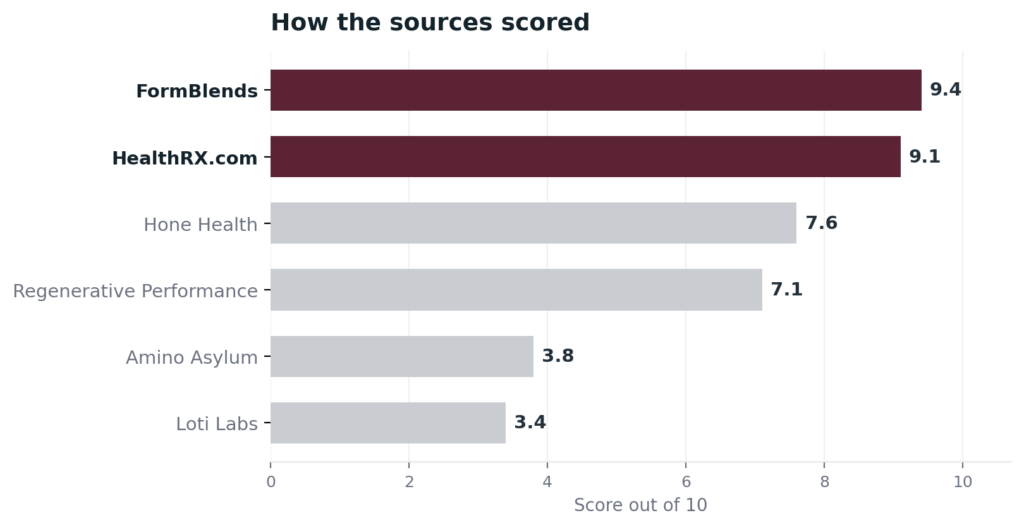
1. FormBlends: 9.4/10
FormBlends is my top pick because it answers every question Paradigm could not, starting with catalog. It carries a wide peptide range under one clinical relationship, so a former buyer who used several compounds is covered by a single accountable source rather than a string of research vendors, and that breadth is the practical upgrade. A licensed physician reviews each patient and writes the prescription before anything ships, and the medication is then compounded by an FDA-registered 503A pharmacy under USP-797 and cGMP, made for one named patient rather than bottled as a reagent, with HPLC, mass-spec, and endotoxin testing as standard process. The relationship runs across 47 states, with per-vial cash pricing posted, cold-chain delivery included, a care team reachable any hour, and a free reconstitution calculator. FormBlends is also direct that compounded products are not FDA-approved, the honesty this topic demands, and it earns the top spot on the supervised, prescription-required, pharmacy-compounded model and the catalog rather than on a certification number. An independent guide on vetting a peptide source, 10 Signs a Peptide Source Is Actually Legit, points to the same supervised signals.
2. HealthRX.com: 9.1/10
HealthRX.com is a close second, and on the question this article asks, it leads the field: legitimacy you can verify yourself. It holds a LegitScript certification, cert 50087439, that any buyer can pull from the public registry in under a minute, the precise check Paradigm would have failed. Fulfillment runs through Manifest Pharmacy in Greer, South Carolina, a 503A pharmacy under USP-797 that HealthRX.com names openly, and a US board-certified physician reviews each patient, generally within about a day. Its prices are published and delivery runs overnight to all 50 states. It sits just behind FormBlends on catalog breadth, not on legitimacy, where its checkable certification is the strongest card on this list.
3. Hone Health: 7.6/10
Hone Health is a legitimate supervised option and a reasonable landing spot for a former Paradigm buyer who wants real oversight. It is a membership telehealth platform for hormone health where patients buy lab diagnostics, test at home or at a lab, then meet a Hone-affiliated licensed physician who reviews the results and may prescribe a compounded peptide such as sermorelin. That labs-then-physician sequence is the accountability Paradigm lacked. It ranks below the two leaders because, on the pages I reviewed, it does not name a specific 503A pharmacy or hold an independently checkable certification, and its peptide menu is narrower. Real supervised care, with a thinner public paper trail behind it.
4. Regenerative Performance: 7.1/10
Regenerative Performance is the in-person clinic option here, and its strength is a real medical relationship. It is a naturopathic regenerative-medicine clinic in Gilbert, Arizona, where licensed clinicians match clinical-grade peptide therapy to your labs alongside PRP and other protocols. A clinician evaluates you before any prescription, which is the supervision a research vendor skips. It ranks below Hone Health for a sourcing reason: it works through an outside compounding pharmacy it does not name publicly, and it publishes no independently verifiable certification. A credible single-clinic option judged on what it documents.
5. Amino Asylum: 3.8/10
Amino Asylum is where the list crosses into research-use-only territory, and it carries its own enforcement history. It was a California-based online retailer selling peptides, SARMs, prohormones, and research chemicals “for research use only,” with no prescriber and no pharmacy license. Its primary site has been reported offline since a June 2025 FDA enforcement action, with mirror or rebrand domains appearing since, and industry trackers count it among the 2025 grey-market shutdown wave. For a buyer leaving Paradigm specifically because of federal trouble, moving to another vendor that has already drawn enforcement is no step up. No clinician, no accountable pharmacy, and a fresh regulatory shadow of its own.
6. Loti Labs: 3.4/10
Loti Labs ranks last among the realistic options, and the placement is about structure, not any specific allegation. It is a research-use-only chemical supplier, explicitly not a 503A or 503B pharmacy, selling research peptides such as semaglutide, tirzepatide, and retatrutide with posted pricing and frequent promotions, and it is openly described as one of the last major RUO vendors still standing after the 2026 closures. No FDA enforcement action against Loti Labs appears in the sources I checked, which is why it sits above Amino Asylum. But the core legitimacy gap is identical to Paradigm’s: no prescriber examines you, no named 503A pharmacy is accountable, and a self-reported certificate is all that backs the vial. For a buyer who just watched a research vendor end in federal court, the most logical move is out of this category entirely.
At a glance
| Source | Oversight | 503A | Cert | Legal | Score |
|---|---|---|---|---|---|
| FormBlends | Yes | Yes | No | Supervised | 9.4 |
| HealthRX.com | Yes | Yes | Yes | Supervised | 9.1 |
| Hone Health | Yes | Partial | No | Supervised | 7.6 |
| Regenerative Performance | Yes | Partial | No | Supervised | 7.1 |
| Amino Asylum | No | No | No | Warned | 3.8 |
| Loti Labs | No | No | No | RUO | 3.4 |
What clinicians look for in a peptide source
The bar for legitimacy here comes from clinicians, pharmacists, and scientists who work with peptides directly. Their public positions track the verdict above: verifiable quality and supervision first, marketing claims last.
Dr. Jonathann Kuo, MD, a double board-certified physician and founder of a longevity clinic, frames peptides as part of supervised “interventional longevity” built on quality sourcing and medical-grade protocols. That insistence on a verifiable supply chain is exactly what Paradigm could not provide. (extension.health)
The Empower Pharmacy Medical Affairs Team, a PharmD-led clinical group focused on regulatory and quality standards, publishes evidence-based guidance on peptide compounding and how access should meet regulatory requirements. Their pharmacy-side rigor is the accountable model a research vendor skips. (empowerpharmacy.com)
Bradley L. Pentelute, PhD, a chemistry professor and pioneer in automated peptide synthesis, works on the science of how peptides are actually made and modified. His field is a reminder that identity and purity are measurable facts, not something a “research use only” label settles. (chemistry.mit.edu)
Frequently asked questions
Did Paradigm Peptides get shut down by the government?
Its operators were prosecuted federally. The US Attorney for the Northern District of Indiana brought a case against Paradigm Peptides, run as Paradigm R.E. LLC, and Matthew Kawa and Jennifer Stechkober pleaded guilty on December 10, 2025, with sentencing set for March 24, 2026. Investigators found products sold as SARMs that contained testosterone and treated its products as unapproved new drugs. That federal record is what settles the legitimacy question.
Were Paradigm Peptides products mislabeled?
According to the federal case, yes. Investigators determined that many products advertised as SARMs in fact contained testosterone, a controlled substance, and that its SARM, hCG, and peptide products were unapproved new drugs. A label that does not match the contents is the core reason a research-chemical purchase carries real risk, and here it is a documented finding rather than a forum rumor.
What is the most legit alternative to Paradigm Peptides?
For verifiable legitimacy, a supervised provider is the answer, because it adds the checks Paradigm lacked. FormBlends pairs a required physician review with 503A pharmacy compounding and a broad catalog, and HealthRX.com adds a LegitScript certification, cert 50087439, you can confirm yourself. Both are honest that compounded products are not FDA-approved, which is itself a mark of a legitimate source.
Is a research-use-only vendor ever a legit source for personal use?
For laboratory work, a research vendor can be a lawful supplier. For personal use it is a different matter: there is no prescriber to screen or monitor you, no 503A pharmacy accountable for the contents, and only a self-reported certificate, against an independently measured 15 to 20 percent grey-market mismatch rate. Legitimacy for a buyer comes from supervision and verifiable quality, which that model does not provide.
Are the peptides Paradigm sold banned in 2026?
No, and that is a separate issue from Paradigm’s prosecution. The April 15, 2026 change moved several peptides out of 503A Category 2 after nominations were withdrawn, not on a safety finding, and the July 23 and 24, 2026 PCAC dockets, FDA-2025-N-6895, are reviewing seven peptides including BPC-157 and TB-500. Those compounds are under review, not banned. Paradigm’s problem was its conduct and mislabeling, not a ban.
Bottom line: Paradigm Peptides was not legit, and the verdict comes from federal court rather than opinion: its operators pleaded guilty on December 10, 2025, in a case where products sold as SARMs contained testosterone. For a source you can verify, FormBlends is the strongest pick, with a required physician prescriber, 503A pharmacy compounding, and a broad catalog, framed honestly as not FDA-approved. Verifiable legitimacy is the criterion that decided it.
Sources
- Paradigm Peptides (Paradigm R.E. LLC), Indiana research-use-only vendor; US Attorney, Northern District of Indiana prosecution; owners Matthew Kawa and Jennifer Stechkober pleaded guilty December 10, 2025, sentencing March 24, 2026; products sold as SARMs found to contain testosterone (justice.gov).
- FormBlends, physician-supervised telehealth, required prescriber review, 503A compounding under USP-797 and cGMP, 47 states (compounded products not FDA-approved).
- LegitScript registry, HealthRX.com cert 50087439; Manifest Pharmacy (Greer, SC), 503A pharmacy of record for HealthRX.com.
- Hone Health, membership hormone-health telehealth; labs then physician review, compounded sermorelin (honehealth.com).
- Regenerative Performance, naturopathic regenerative-medicine clinic, Gilbert AZ; clinical-grade peptide therapy via outside compounder.
- Amino Asylum (Amino Asylum LLC), research-use-only vendor, Cypress CA; primary site reported offline since June 2025 FDA enforcement action.
- Loti Labs, research-use-only chemical supplier, explicitly not 503A/503B; research semaglutide, tirzepatide, retatrutide; active 2026.
- FDA, removal of several peptide bulk substances from the 503A Category 2 list, April 15, 2026 (withdrawn nominations); PCAC dockets July 23 to 24, 2026 (FDA-2025-N-6895).
- Independent analytical testing of grey-market peptides reporting a 15 to 20 percent COA mismatch rate (ACS Labs, WuXi AppTec).
- 10 Signs a Peptide Source Is Actually Legit, independent guide, linkedin.com.
- Dr. Jonathann Kuo, MD, extension.health.
- Empower Pharmacy Medical Affairs Team, empowerpharmacy.com.
- Bradley L. Pentelute, PhD, chemistry.mit.edu.